Newsletters
Regular newsletters are published several times per year to record activities and experiences of Group members in cultivating Australian container plants.
Many of the Group’s newsletters and reports are provided here as an archive. The newsletters are in pdf format and will require a PDF Reader to view them. (Free readers include Foxit Reader and Adobe Acrobat Reader).
View Newsletters
Why We Grow Australian Natives in Pots?
Below are our thoughts on reasons why. Feel free to suggest other reasons and send us your examples, thoughts and pictures. We want to start a conversation.
For beauty:
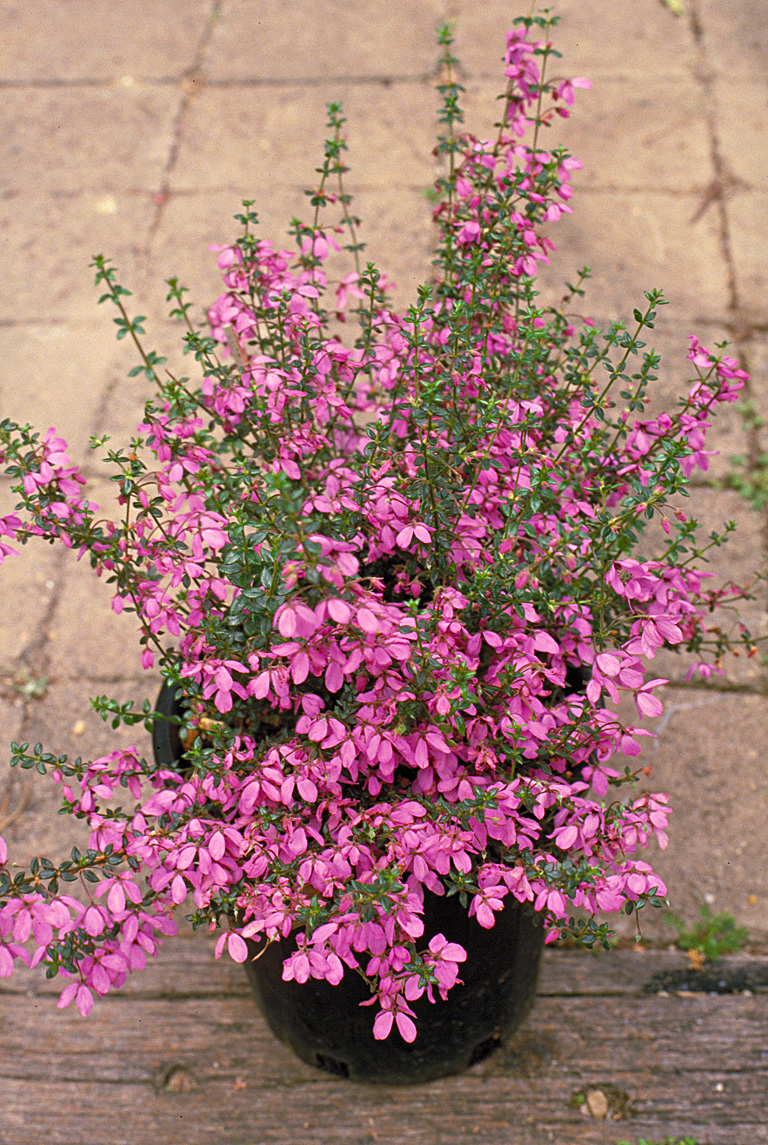
Everyone gasps when they see Qualup Bell in full bloom. The colour and shape of the flowers is unusual, lime green bells, sometimes with very dark red sepals. The birds love these flowers and visit them regularly, standing on tiptoe to drink nectar.
![]() |
![]() |
|
| Left: Pimelia physodes in a pot at the Walcott house Right: Flowers from a different cultivar in a pot at the Australian National Botanic Gardens |
||
For food:
Australian citrus fruits make great marmalade, very tangy and unusual. They are also attractive accents to salads and drinks. These plants are very pleasing in a decorative pot as the fruits are colourful and long lasting.
![]() |
|
![]() |
| Left: Citrus ‘Sunrise Line’ plant and top middle, the fruit which has a sweet rind and tart flesh Right: Citrus ‘Rainforest Pearl’ plant and bottom middle, the fruit. |
||
Because they don’t like our soils:
In Canberra we have clay soils. While clay soils are nutritious, they do not drain well, and many plants, including Western Australian banksias, do not appreciate wet feet. We grow these marvellous plants in a mix of 2/3 native potting mix and 1/3 sand to have beautiful flowers all through winter and food for the birds.
![]() |
|
![]() |
| Left: Summer location of some of our pots including banksias Centre: Banksia victoriae Right: Banksia oreophila | ||
Because they don’t like our climate:
Eremophila flaccida is a glorious plant, but it does not like our winter frost in Canberra. We have tried protecting it indoors, but it still sulks. Corymbia ‘Summer Red’ is another plant that does better in a pot in Canberra.
![]() |
![]() |
|
| Left: Corymba ‘Summer Red’ (photo by Rowan Ward) Right: Eremophila flaccida flower | ||
Because we need flowers in our border:
You can spice up your border instantly with the addition of plants in pots. When they stop flowering, you can remove them from the border until they bloom again next year.
Because the plant grows better in a pot:
We have tried Correa ‘Canberra Bells’ in the garden, but it does much better in a pot. The drainage is better, the soil is lighter, and it blooms extravagantly. This plant can have over 100 blooms at one time.
![]() |
![]() |
For outdoor decoration:
The clear blues, reds and golds of Lechenaultia are colours that are hard to find in other plants. Lechenaultia grows well in pots in parts of Australia where it will not thrive in the ground.
![]() |
![]() |
|
| Left: Lechenaultia ‘Eldorado’ Right: Lechenaultia biloba | ||
For indoor decoration:
Palms will not grow in our frosty climate (except for the wonderful Livistona australis) but will do well in pots. They are traditionally decorative indoors where they thrive without too much light. The Kentia Palm from Lord Howe Island, Howea forsteriana, is a worldwide favourite indoor plant.
To make a statement:
You cannot make a more Australian statement than a Wollemi Pine in a pot at your front door. Many of our members will be lucky enough to be able to grow this magnificent plant well in their gardens, but for us, they grow best in a large container. Rhodanthe anthemoides also makes an excellent pot plant.
![]() |
![]() |
For rare and special plants:
We love the contrast between the orange flowers and grey foliage of Diplolaena grandiflora and this plant blooms for a long time over winter. Native orchids of all kinds do well in pots
![]() |
![]() |
|
| Left: Sarcochilus hybrid (native orchid) Right: Diplolaena grandiflora | ||
For annuals:
Ptilotus do not last more than a year in our garden, but Ptilotus ‘Joey’ makes a terrific annual in a pot, compact, floriferous and showy.
For scent:
Boronia is a must near the front or back door, so that every time you go out you can catch the glorious scent (for the 75% of people who can smell Boronia). Prostanthera, and other plants with strongly scented leaves, are also great to have by the door, so that you can brush past them or trail your hand through the foliage.
![]() |
| Boronia megastima (photo by Geoff Lay) |
For serenity:
Maidenhair Fern, in all its forms, Common (Adiantum aethiopicum), Giant (Adiantum formosum), and Rough (Adiantum hispiulum), grow well in containers (photo below left). Their bright green lacy fronds and arching habit are pleasing and calming to the eye.
![]() |
![]() |
|
| Left: Maidenhair Fern Right: Plants arranged in pots for an ANPS Canberra sale (photo by Lucinda Royston) | ||
For propagation:
All native plants that are propagated by cuttings or seed start off in pots. Often they will be moved from smaller to larger pots as they grow before they are sold (photo above right).
What Sort of Containers Do You Use?
Plastic:
Plastic containers are light, easy to move, and retain water in dry climates. They can retain too much water in wetter climates and the plants can rot. Some plastic containers that we now use are grooved at the base for good drainage and get rid of the need for feet. The best feet are those triangular ones that are flat. These do not break as the ceramic raised ones do.
![]() |
![]() |
In the left picture, the two pots in the back are plastic with grooved bases. The left one is in a tray which is kept full of water as this Boronia likes to be wet. In the right picture, a Banksia grandis (dwarf form) is growing in a large plastic pot which is raised on feet.
Ceramic:
Ceramic pots come in a dizzying array of colours and designs (see left photo above in the foreground). They can really make an artistic statement massed together. The stunning garden, Majorelle, in Marrakesh, Morocco, has two or three differently coloured pots throughout the whole garden as a striking theme. Pipes can also make useful containers as you can see below. Here a Banksia baxteri is in a large ceramic ‘tube’ planted in the ground.
![]() |
![]() |
|
| Left: A Banksia baxteri at the ANBG in a ‘pipe’ Right: Banksia serrata as bonsai at the National Arboretum | ||
Clay or terracotta:
Clay pots are traditional and can be very decorative. They transpire water through the clay so that they dry out relatively quickly. This feature can be both an advantage and disadvantage, depending on the conditions. Some believe that it keeps the roots cooler in the hot days of summer.
![]() |
![]() |
Plain terracotta pot on the left and a terracotta trough on the right with ferns. Both types require feet to lift them off the ground for drainage.
Metal:
Metal pots can be very functional and some are extremely beautiful, for example bright brass pots.
![]() |
![]() |
|
| Left: Metal pot on wheels at the National Arboretum with native plants. Right: Moroccan brass pot | ||
Wooden:
Barrels can make very successful display pots, especially when massed with colourful plants.
![]() |
![]() |
Container Shapes:
The very worst sort of container is one that narrows or pinches to the neck. These pots should be discouraged from the market as often you cannot repot without breaking the container. It can sometimes be the best of both worlds to enclose a plastic pot in a decorative ceramic pot. This arrangement allows repoting with ease and makes moving pots a less difficult task.
![]() |
| A variety of pots in Andy and Janet Russell’s balcony garden |
Potting up:
We do not plant in a small container if the plant is eventually going to be large. You can plant a small plant in a large container and let it grow to fill the pot. This means that you do not have to disturb the plant by potting up to the next sized pot every few years. Of course, you can pot up regularly if it suits you better, but it involves more work for you and more disturbance to the plant.
What soil mix do you use in your pots?
We use a mixture of roughly 1/3 coarse landscape sand and 2/3 native potting mix. The potting mix (a local brand from Martins in Yass) consists of composted organic material with added water crystals and native fertilizer. The proportion of sand to potting mix will vary with the plant type, with those that need really good drainage getting more sand.
What mulch do you use on your pots, if any?
For most of our pots, we use a pebble mulch but on some of the bigger pots we use an organic mulch which consists of shredded and composted plant material from the local tip. We believe that mulch not only suppresses weeds but also conserves water.
Watering:
If you have a plant that needs more water than most others you can put a dish underneath the plant and keep that full of water. We have found this useful for Boronia heterophylla, which seems to be more thirsty than our other boronias. In summer you have to be prepared to water every day. In winter watering every fortnight can often be enough.
Fertilizing:
We fertilize very sparingly with only a light scattering of granules, as we want more flowers and not so much foli-age. We use a granular native fertilizer ( N 9.2, Phos 2.2, K 5.8, S 13.8, Ca 4.5) spring and autumn.
Pruning:
Regular pruning of your plants in pots can result in healthier plants and more pleasing shapes. At the end of summer we prune all our plants in containers ready for winter.
Container Plants Resources
These are a few internet and other resources on cultivating Australian plants in containers that might prove useful.
Books:
Most, if not all, of the following are out-of-print but may be available through municipal libraries.
- Blombery, A (1983), Growing Australian Natives in Pots: Indoors & Outdoors, Kangaroo Press, Kenthurst, NSW.
- Blombery, A and Maloney, B (2000), Growing Native Plants for Balconies, Courtyards and Townhouses, Simon & Schuster, Australia.
- Elliot, G (1979), Australian Plants for Small Gardens and Containers, Hyland House, Melbourne.
- Elliot, G (1988), The New Australian Plants for Small Gardens and Containers, Hyland House, Melbourne.
- Molyneux, B & Forrester, S (1986, 1992), Native Gardens in Minature, Australian Plants in Containers, Kangaroo Press, Kenthurst, NSW.
- Ratcliffe, D & P (1987), Australian Plants for Indoors, Little Hills Press.
- Wrigley, J and Fagg, M (1992), Growing Native Plants Indoors, Simon and Schuster, Australia.
Journals:
Several issues of the Society’s journal Australian Plants are particularly useful for those interested in growing potted plants. Back issues of Australian Plants have been digitised and can be searched and viewed online. Searching these for ‘container plants’ may find useful references.
- Vol 6, No.48 September 1971; Natives for Window Boxes.
- Vol 12, No.94 March 1983; Australian Plants in Containers.
- Vol 13, No.102 March 1985; House Plants – Proven Natives and Their Care.
- Vol 13, No.107 June 1986; Palms for Containers.
- Vol 13, No.107 June 1986; Potted Plants (Fertilizers and Potting Mixes).
- Vol 14, No.114 March 1988; Waratah as a Container Plant (part of a general article ‘Grow Waratah from Seed to Flower’).
- Vol 15, No.124 September 1990; Sturt’s Desert Pea – A Flowering Pot Plant.
- Vol 19, No.155 June 1998; Daisies as Potted Plants.
- Vol 21, No.168 September 2001; Callistemon – Growing in Large Pots.
- Vol 21, No.169 December 2001; Container Plants for Balconies.
Internet:
- Best Australian Native Plants for Pots and Containers (from ‘Gardening With Angus’).
- Growing Australian Native Plants in Containers
- Growing Natives in Pots; Gardening Australia Fact Sheet
- Hang ’em High!; Australian plants for hanging baskets
- My Favourite Rainforest Plants for Containers
Australian Native Plants Society (Australia)