 Australian Native Plants Society (Australia)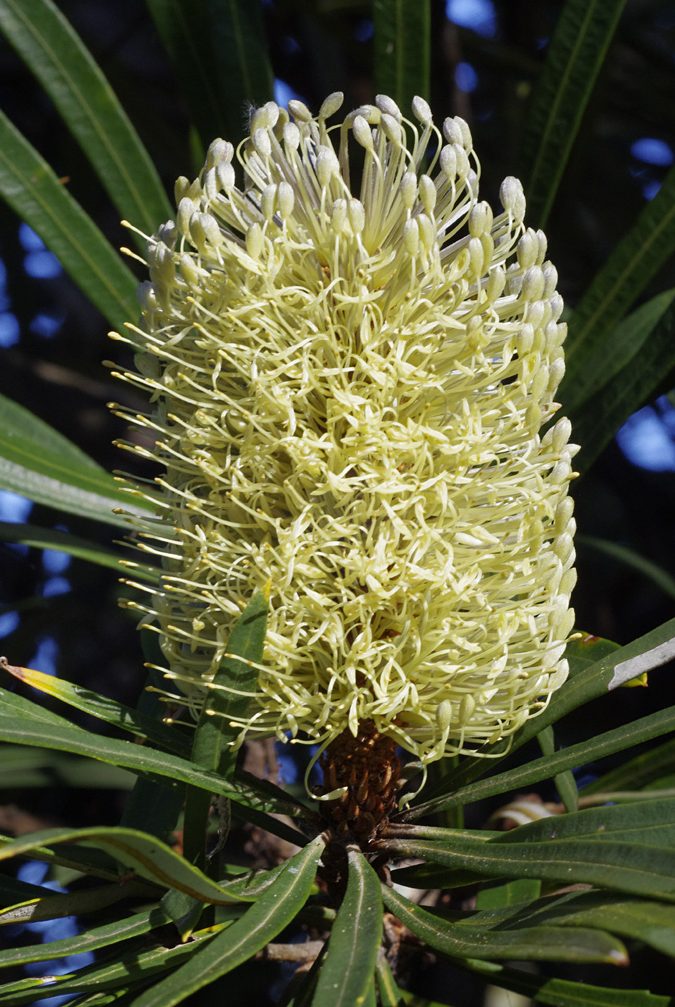
Join
Membership is available to members of an ANPSA-affiliated Regional Society. If you are not a member of a Regional Society, If you are not a member of a Regional Society, please contact the Society located in your State or Territory for further information.
Membership of the Banksia Study Group is $7 paid annually (or in advance for two years if so desired).
To join the Banksia Study Group, please send a request using the following form (please note that all fields are mandatory* – you may edit the ‘Message’ field if necessary).
Banksia Study Group Form
Signup form for the Banksia Study Group that sends a notification to the Study Group leader.
Background
Who we are. What we do. And a bit of history.
Who We Are
The Banksia Study Group consists of a scattering of people keen on growing, cultivating and finding banksias across Australia. Members comprise both interested amateur growers as well as professional botanists and horticulturists.
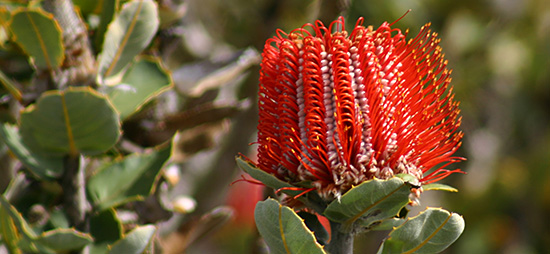
Banksia is a large genus of over 200 species in the Protea family (Proteaceae). The size of the genus was expanded in 2007 when the genus Dryandra was merged into Banksia, although this reclassification is not accepted by either the Banksia or Dryandra Study Groups – see ‘Dryandra or Banksia?’ below.
All Banksia species occur in Australia with one (B.dentata) extending to islands to Australia’s north. Banksias can be found in most environments; the tropics, sub-alpine areas, the coast and desert areas. The most diversity in the genus occurs in the south of Western Australia where over 80% of the species occur.
Banksias are very popular plants in cultivation because of their colourful flowers, dramatic foliage and their role in attracting birds to the garden. They are successfully grown in every state and territory of Australia – provided that species are selected that are suited to the environment where they are cultivated. One of the problems faced by growers is the difficulty in successfully growing Western Australian species in areas of the east coast where there are wet, humid summers.
The Banksia Study Group was set up to address this and other issues. Some broad aims of the group are to:
- investigate naturally occurring forms that have horticultural potential
- investigate grafting as a means of extending the range where species can be successfully grown
- investigate any weed potential of species when grown away from their natural environment
- compile cultivation reports for a variety of locations.
Note that the Study Group’s interests do not include those species which were formerly classified as Dryandra. The Dryandra Study Group remains active and concentrates on the ‘Dryandra Group’ of banksias.
History
The following article, which covers the history of the Study Group up until about 2000, is based on one published in the newsletter of the Banksia Study Group, Vol. 3 No. 1 December 2000. It was written by Trevor Blake, who was Study Group leader from 1973-2000.
**************
It may be worth my while reflecting on the Banksia Study Group over the last twenty years or so. In this way we may be able to trace the changes and reasons for developing the group the way it became. Initially it was one of the earliest study groups to come into being, along with hakea, and pea.
The seeds, as I remember them, were sown by Maroondah District Group of the then Society for Growing Australian Plants at a time when they were conducting native plant identification courses and seminars on groups of plants to improve understanding of the range of species available for selection. Over a period as wide a range as possible of species were propagated for distribution during the seminar weekend. Amazing species came to light, many only heard of or read about in books or herbarium journals. Some of those seminars included Goodeniaceae, Epacris, Darwinia, Fabaceae, Correa and Eremophila. Booklets of notes were published and enthusiasts and plant growers of the genera focused on were invited to talk to Maroondah Group at their Friday evening meeting which launched the seminar. They were extremely successful and the enthusiasm generated matured into some of the well known and valued publications on Australian flora that continue on today.
Jim Carney began a group to study Western Australian banksias as they were reliably unreliable in the eastern states and particularly in the shallow clay soils around Melbourne. Jim produced the first of these “Western Banksia Study” reports in June 1972 but tragically he was killed early the following year and as I had been fairly closely associated with the study I took over. Because of the interest shown in the genus, I decided to expand the study to cover all of the species. A second report was published in June 1973 and was one that had been started by Jim. A third report, which was expanded to some 38 pages was produced in June 1974 and at this stage Alf Salkin, who was undertaking his Masters degree in banksias, became heavily involved and remained a great source of knowledge and enthusiasm throughout.
Our efforts to sustain a seed supply became frustrating as the seed sent into the seed bank was generally fairly commonly available, and we were buying from the same suppliers as the public could access.
The demand, of course, was for all the scarce or rare species, so we decided to discontinue this practice and publish all the known suppliers. Our aim was to publish all worthwhile information and not conduct a chatterbox newsletter every few months, This practice did not fit in with the regular study group format. There were no fees and the only revenue raised was when a report was available and these were advertised in the state newsletters and Australian Plants. A great deal of letter writing took place and I always encouraged people to contribute articles or tell of their experiences, both good and bad. Only when enough worthwhile data amassed was another report produced, as a result we had no membership, but instead a loose group that I could write to for information etc. This suited my style, my interest in banksias and my available time.
On a couple of occasions I set about closing the group down and suggested that it be combined with the Dryandra Study Group, but was talked back into keeping it going.
Alf Salkin was well under way with his degree and was finding lots of fascinating data through his research. One of the projects that he needed to carry out was the planting of the enormous collection of seedlings that he had collected seed of on his travels up the east coast. The Royal Botanic Gardens at Cranbourne provided a site where he could do just this, and with all the redevelopment that is being carried out, most of this has been retained. His enthusiasm expanded and he eventually took over a sandhill, where most Banksia, and a wide range of other Proteaceae species, were grown.
Banksia Study Report #4 was produced in 1977, #5 in 1979, #6 in 1982, #7 in 1986, #8 in 1988, #9 in 1992, and #10 in 1995.
In the meantime of course, the genus was revised in the journal from the Western Australian Herbarium by Alex George “Nuytsia ” Vol. 3 No. 3, 1981 and then The Banksia Book by A. George was produced. At the same time Celia Rosser had started on the first of her 3 tomes which were finally completed in 1999. A major study of the genus began and resulted in the Banksia Atlas in 1988 which added to our knowledge of the whereabouts of all the species, and in so doing unearthed many more interesting variations. Back in 1982 the Elliot & Jones Encyclopaedia Vol. 2 was produced with the genus being covered from a horticultural point of view and updated in the first supplement in 1994. Wrigley & Fagg also produced a text on Proteaceae covering all species of Banksia in 1989 which had emphasis placed on their horticulture. The long awaited “Flora of Australia ” Vol. 17B was published in 1999 and both Victoria and New South Wales covered Banksia in their respective Flora’s published over the last ten years.
It was interesting that of all the ‘new’ species named since that 1972 revision, and there were many, and despite repeated requests for information on their growing, germination etc. in all SGAP publications both state and national, only a handful of reports emerged which indicated that they were either not known and grown, or that people just hadn’t got round to sending in data.
A healthy cut flower trade has developed during the last twenty years, some being genuinely interested in promoting the genus as a genuine “Aussie “flower and those that we are all too aware of in making sure that they muddy the waters and flog anything that grows in this country as Australian natives.
These we know are represented by proteas, leucadendrons, and other such South African species, which is a pretty poor reflection on those companies.
Newsletters and Reports
The Group’s newsletters record activities and experiences of Group members in cultivating banksias, keeping up to date on scientific knowledge of the genus and reporting on field trips to various parts of Australia.
Most of the Group’s newsletters and reports are provided here as an archive (Note: These are in pdf format and will require a PDF Reader to view them. Free readers include Foxit Reader and Adobe Acrobat Reader).
No newsletters were produced for a period from 2013 to early 2017 while the Study Group was in recess.
****Click here to access the Banksia Study Group Newsletters and Reports*****
Banksia Plant Profiles
Profiles of about 50 species of Banksia have been incorporated into the Banksia section of the website, which can be found under ‘Plant Guides > Common Plant Genera and Families’ . Each profile includes a photograph and information on natural distribution, taxonomy, cultivation and propagation.
Click here to view the Banksia profiles
The Banksia section of the website also covers the characteristics, cultivation and propagation of banksias generally, and include references to other relevant resources.
Click here to view the Banksia section
Banksia Resources
These are a few internet and other resources on Banksia that might prove useful:
Books:
- Cavanagh A and Pieroni M (2006), The Dryandra Book, Australian Plants Society (SGAP Victoria) Inc and Wildflower Society of Western Australia Inc. in association with Bloomings Books, Melbourne.
- Collins, K, Collins, C and George, A (2008), Banksias, Bloomings Books.
- Elliot, W. R and Jones D (1982), The Encyclopaedia of Australian Plants, Vol.2, Lothian Publishing Company Pty Ltd, Melbourne.
- Elliot, W. R and Jones D (1984), The Encyclopaedia of Australian Plants, Vol.3, Lothian Publishing Company Pty Ltd, Melbourne.
- George, A (1981) The Genus Banksia in “Nuytsia” Vol.3 No.3, The Western Australian Herbarium, Department of Agriculture, Western Australia.
- George, A.S (1984). An Introduction to the Proteaceae of Western Australia, Kangaroo Press, Kenthurst.
- George, A (1996), The Banksia Book, 3rd Edition, Kangaroo Press in association with the Society for Growing Australian Plants.
- George, A.S (1996). New taxa and a new infrageneric classification in Dryandra R.Br.(Proteaceae: Grevilleoideae). Nuytsia 10(3): 313 – 408.
- Griffin E.A (1985). Studies in the genus Dryandra R.Br. (Proteaceae) 1. Species distribution, ecology and conservation status, Western Australian Herbarium Research Notes, No.11: 1 – 40.
- Holliday, I and Watton, G (1990), A Field Guide to Banksias, Hamlyn Publishers, Port Melbourne.
- Sainsbury, R (1984). Field guide to Dryandra, University of Western Australia Press, Nedlands.
- Taylor, A and Hopper, S (1988), The Banksia Atlas, Australian Flora and Fauna Series, No.8, Australian Government Publishing Service.
- Wallace, I (2010), An Illustrated Guide to Eastern Banksias, published by the author.
- Wrigley, J and Fagg, M (1989), Banksias, Waratahs and Grevilleas, Collins Publishers Australia.
Journals:
Several issues of the Society’s journal “Australian Plants” are particularly useful for those interested in Banksia.
- Vol 9, No.71 Jume 1977; Banksia propagation and culture; Growing western Banksia in Canberra.
- Vol 13, No.105 December 1985; Banksia integrifolia and its relatives.
- Vol 14, No.114 March 1988; Description of eastern Banksia species with many photos.
- Vol 15, No.124 September 1990; Description of western Banksia species with many photos; The Banksia flower.
- Vol 18, No.141 December 1994; “Landscaping with Dryandra” and “A Growing Guide for Beginners”.
- Vol 20, No.158 March 1999; Banksia coccinea cultivars; Banksia – detailed review of botany, cultivation and propagation.
- Vol 20, No.160 September 1999; Banksia plagiocarpa; some notes on northern Queensland banksias
- Vol 20, No.160 September 1999; “The ‘Honeypot’ Dryandras”; Dryandra seed germination.
- Vol.21 No.166 March 2001; Detailed report on Banksia propagation and cultivation; In-vitro propagation.
- Vol.21 No.173 December 2002; Banksia in Horticulture; Banksia tricuspis; numerous photos.
Internet:
- A Feast of Banksias
- Banksia – Australian National Botanic Gardens.
- Banksia as Bonsai.
- Could this be Australia’s rarest Banksia? Banksia vincentia (Proteaceae), a new species known from fourteen plants from south-eastern New South Wales, Australia (pdf)
- Cultivation of Dryandra
- Dryandra cladistic classification to Banksia – naming dispute. A personal view from Kevin Collins of The Banksia Farm, Mt Barker, Western Australia.
- Growing Native Plants – a series of plant profiles by the Australian National Botanic Gardens; includes a number of banksias.
- Growing Banksias in Northern Victoria
- Growing Western Banksias in Containers
- Holly-leaved Banksia – Banksia ilicifolia
- The Dryandras – About the Book
- The Propagation of Banksia
- Starlight’s Banksia – Banksia paludosa subsp. astrolux
- So Dryandra Becomes Banksia – What’s All the Fuss About? A comment on the taxonomy behind the proposed reclassification of Dryandra into Banksia.
- Wallum Banksia – Banksia aemula
- Why dryandras have changed their name. The justification for the transfer of Dryandra to Banksia.
- You Don’t Have to call Dryandra Banksia. Just because new taxonomy has been published, doesn’t mean you have to accept it.
Dryandra or Banksia?
A paper published in February 2007* proposed that the genus Dryandra be subsumed into Banksia. The paper published new names in Banksia for all (then) currently recognised Dryandra species. This revised classification has been accepted by the Council of Heads of Australasian Herbaria and the new names now appear on Florabase (the website for the Western Australian Herbarium) and in the Australian Plant Census
However, the reclassification has not met with universal approval. For example, Alex George, a highly respected authority on both Banksia and Dryandra, strongly opposes the change on scientific grounds. The two opposing views are set out in the following articles:
- You don’t have to call Dryandra Banksia” by Alex George.
- Why dryandras have changed their name by Kevin Thiele.
|
|
* Mast A R and Thiele K; The transfer of Dryandra R.Br. to Banksia L.f. (Proteaceae); Australian Systematic Botany, 26 February 2007
ANPSA recognises the Australian Plant Census as the authority on plant names and, accordingly, the revised classification has now been adopted on the ANPSA website. However, ANPSA’s Dryandra and Banksia Study Groups both regard the two genera as separate and, for this reason, the Banksia Study Group restricts its interest to the previous classification of approximately 80 species.