 Australian Native Plants Society (Australia)
General Description:
Acacia elongata is an upright, open shrub to small tree from about 1,5 metres to 7 metres in height. Like most members of the genus, the mature plant does not have true leaves but has leaf-like flattened stems called phyllodes. In A.elongata the phyllodes are linear in shape from 50-130 mm long by about 3 mm wide with prominent longitudal veins and ending in a short point. The phyllodes are often curved. The lemon-yellow flower clusters occur in the axils of the phyllodes. Flowering is mainly in late winter and spring.
A.elongata is not widely cultivated but smaller forms are excellent garden plants that grow quickly and flower within one or two years from seed. It is reliable in a range of soils and flowers best in full sun or dappled shade. This species is often found in moist soils and is adaptable to areas which suffer short periods of inundation.
Propagation is relatively easy by normal seed raising methods following pretreatment by soaking in boiling water or by scarification. Cuttings may also be successful.
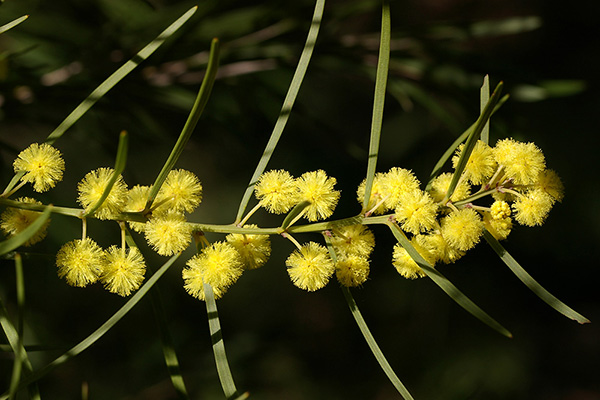
Acacia elongata
Photo: Brian Walters