 Australian Native Plants Society (Australia)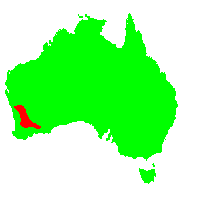
General Description:
Acacia merinthophora has not been seen very much in cultivation but its attractive habit and colourful flowers suggest it should be more widely grown.
It is an open shrub reaching 2.5 metres or more with a weeping habit. The phyllodes are long (up to about 300mm), curved and narrow and are grey-green in colour. The stems of the branches change direction at the points where the phyllodes occur producing a zig-zag shape. The branches make very attractive dried arrangements for indoors.
Short, rod-shaped flower clusters (about 10-15mm long) are produced in the phyllode axils in early winter to early spring. They are bright yellow in colour and are followed by slender, curved seed pods.
Although native to Western Australia, A.merinthophora has been successfully cultivated in humid, east coast areas where many other western species fail. It is best grown in a well-drained, sunny position and, once established, will tolerate extended dry periods.
The species sets some seed in cultivation and propagation is relatively easy by normal seed raising methods. Propagation from cuttings is difficult.
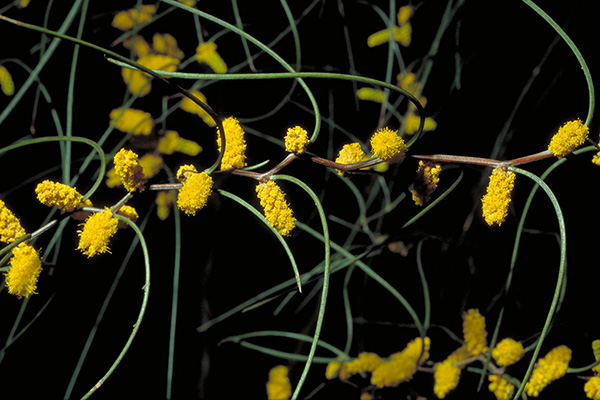
Acacia merinthophora
Photo: Brian Walters