 Australian Native Plants Society (Australia)
General Description:
Acacia podalyriifolia is one of the most popular and widely cultivated of wattles. It is a tall shrub or small tree which reaches about 5 metres in height by a similar spread. Like most members of the genus the mature plant does not have true leaves but has leaf-like flattened stems called phyllodes. In A.podalyriifolia the phyllodes are silvery grey in colour, oval in shape and 20-30mm long.
The flowers occur in ball-shaped clusters in the axils of the phyllodes and a golden yellow in colour. Flowering is mainly in late winter and early spring.
A.podalyriifolia is a quick growing plant which may flower in its second year. It is very useful as a quick growing screening plant as it generally retains a bushy shape. The species is suited to a wide range of climates, particularly drier areas, although it can be effected by sooty mould in humid climates. It tolerates at least moderate frosts.
The species seeds freely and may tend to become invasive in natural bushland areas. It should not be planted in gardens in the vicinity of such areas.
Propagation is relatively easy by normal seed raising methods following pretreatment by soaking in boiling water or by scarification. Propagation from cuttings is not usual.
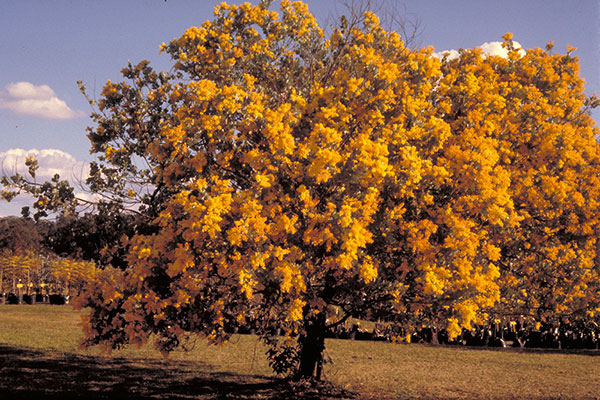
Acacia podalyriifolia
Photo: Brian Walters