 Australian Native Plants Society (Australia)
General Description:
Acacia ulicifolia is a small to medium shrub which may reach 3 metres in height but is usually smaller. Like most members of the genus, the mature plant does not have true leaves but has leaf-like flattened stems called phyllodes. In A.ulicifolia the phyllodes are narrow, rigid and spine-like to 20 mm long with a sharp point. The white or cream flowers occur in globular-shaped clusters from the axils of the phyllodes. Flowering is mainly in winter and spring.
A.ulicifolia is not often cultivated and there are probably more colourful species for use in the garden. However, it is a useful plant which is effective as an informal hedge where its prickly habit can deter access to particular areas and provide refuge for small birds. The plant is suited to a wide range of soil types provided they are reasonably well drained. A position in full sun or light shade is suitable and the species is tolerant of at least moderate frosts.
Propagation is relatively easy by normal seed raising methods following pretreatment by soaking in boiling water or by scarification. Cuttings may be successful but this method is not often used.
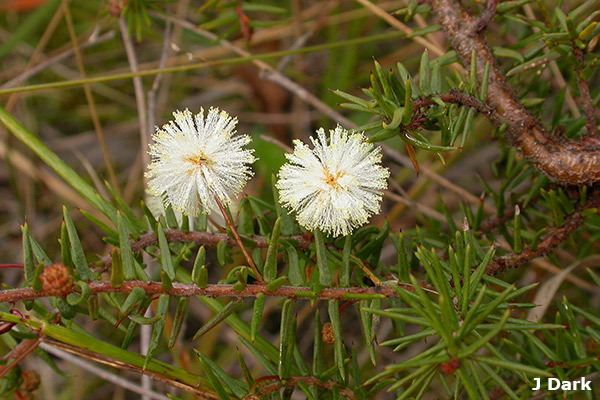
Acacia ulicifolia
Photo: Jill Dark