 Australian Native Plants Society (Australia)
General Description:
Acacia vestita is a medium to large shrub with a pendulous habit about 3 metres in height by a similar width (occasionally larger). Like most members of the genus, the mature plant does not have true leaves but has leaf-like flattened stems called phyllodes. In A.vestita the phyllodes are elliptic or ovate in shape, about 10-20 mm long by about 5-10 mm wide and greyish-green in colour. The phyllodes taper to a fine (but not sharp) point and are hairy, particularly along the margins. The bright yellow flower clusters are globular in shape and are produced in the leaf axils in late winter to spring.
A.vestita is well known in cultivation and is widely planted. It is an attractive and hardy plant, suitable for a wide range of climates and soils, provided they are reasonably well drained, and is best grown in full or partial sun. It is tolerant of at least moderate frost. The plant responds to light pruning if necessary but this should be kept to a minimum to avoid damaging the attractive pendulous habit.
Propagation is relatively easy by normal seed raising methods following pretreatment by soaking in boiling water or by scarification. Propagation from cuttings may also be successful.
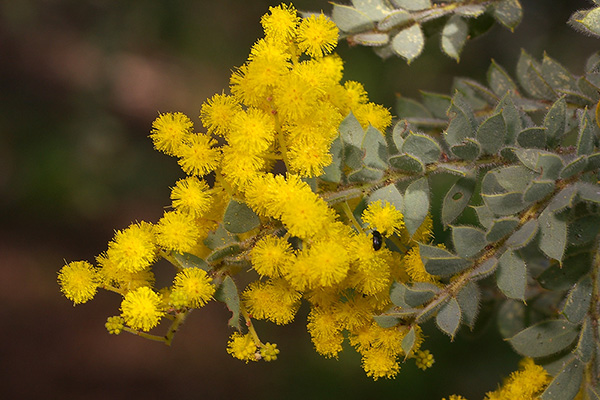
Acacia vestita
Photo: Brian Walters