 Australian Native Plants Society (Australia)
General Description:
Eucalyptus parramattensis, the Parramatta red gum, is a small to medium (10 – 20 metres) usually spreading, shady tree that has either a single trunk or multiple ones. Its bark is deciduous, dark to light grey, although it is sometimes persistent near the base. Its leaves are 8 – 15 cm x 2 cm, lance-shaped (lanceolate), stalked, and light to dull green on both surfaces. The inflorescences are 7 – flowered auxiliary umbels on terete peduncles that are about 1 cm long. The flowers which appear in November to January, are white and attract nectar-eating birds. The capsules grow to 0.5 cm x 0.7 cm, being hemispherical with exserted valves.
Two botanical subspecies and one variety are recognised. E.parramattensis subsp.parramattensis differs from subsp. decadens in having shorter bud caps (opercula). E.parramattensis var. sphaerocalyx has short, rounded bud caps in contrast to the usual conical caps.
Although not often cultivated, E.parramattensis is an attractive tree of moderate size that is hardy in heavy soils with plenty of sun and moisture. Calgaroo flowers profusely and is attractive to birds.
Propagation is from seed which germinates readily.
* EPBC Act = Environment Protection and Biodiversity Conservation Act 1999;
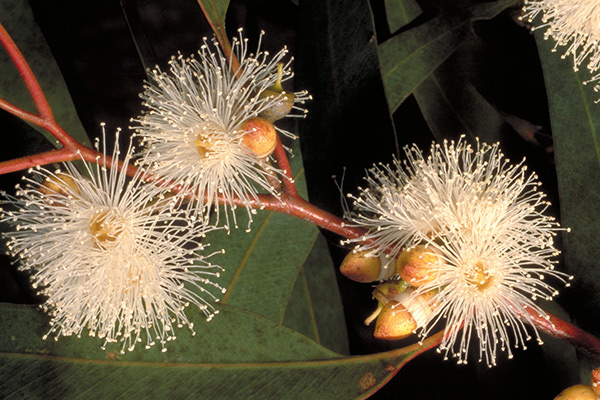
Eucalyptus parramattensis
Photo: Brian Walters