 Australian Native Plants Society (Australia)
General Description:
Eucalyptus youngiana is one of the most attractive of the eucalypts. Its relatively small size and large, colourful flowers make it a very desirable species for cultivation in suitable climates. It is usually a tree of mallee habit (multi-trunked) up to 11 metres in height with a rough, flaky bark which is persistant on the trunks and lower parts of the main branches. The mature leaves are broadly lanceolate and up to 150mm long.
The main features of E.youngiana from a horticultural point of view are the large flowers which may be 75mm in diameter. The flower colour may be red, yellow or cream and they occur from late winter through to early summer. The “gumnuts” which follow the flowers are also an interesting feature of the tree. They are large and conspicuously ribbed.
As a species native to relatively dry areas, E.youngiana is best suited to cultivation in climates which have a dry summer. It has been grown in sub tropical districts but cannot be regarded as reliable in those areas. The species responds well to hard pruning almost to ground level if rejuvenation is required.
Propagation is from seed which germinates readily.
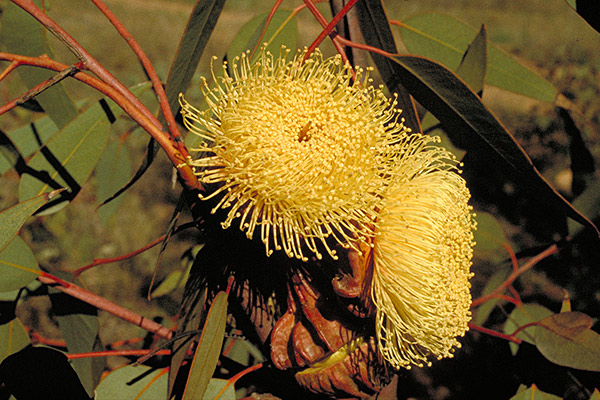
Eucalyptus youngiana
Photo: Brian Walters