 Australian Native Plants Society (Australia)
General Description:
Grevillea hookeriana is typical of the “toothbrush”-flowered grevilleas where the individual flowers are arranged in a terminal one-sided raceme. It is a fairly variable species and may be revised as a result of future research.
Grevillea hookeriana is usually a medium shrub which can reach 2.5 metres high by a similar width. However, some forms have a much lower growth habit. The leaves are up to 12 cm long and may be entire or deeply lobed with narrow segments. Flowers occur in toothbrush-shaped clusters at the ends of the branches in winter to spring. The flower colour varies from dark red to almost black.
There is some confusion regarding G.hookeriana in the horticultural trade. A plant with bright red toothbrush flowers has been sold under this name for many years. However, it has been established that this is a plant of hybrid origin (thought to be G.longifolia x G.tetragonoloba) and may not have G.hookerana in its parentage. This plant is now more commonly available as Grevillea ‘Red Hooks’ and is registered with the Australian Cultivar Registration Authority (ACRA 410).
The true G.hookeriana is mainly cultivated by enthusiasts and is less hardy than the hybrid plant, particularly in areas with humid summer climates. It requires well drained soils in sunny or semi-shaded situations. It tolerates extended dry periods once established and is tolerant of at least moderate frosts.
Propagation is best carried out from cuttings of firm, current seasons growth which strike reasonably reliably. Seed may be successful but is not readily available.
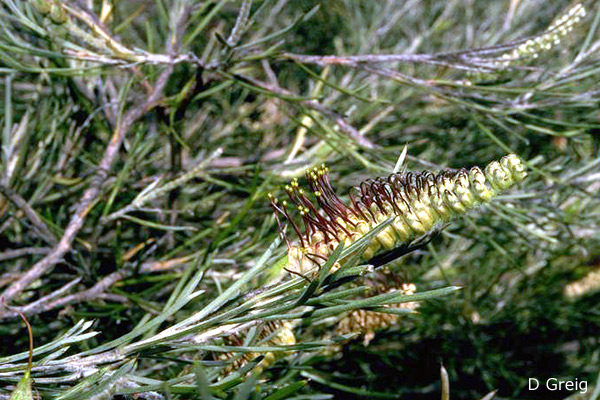
Red-black form of Grevillea hookeriana
Photo: Denise Greig – Australian National Botanic Gardens
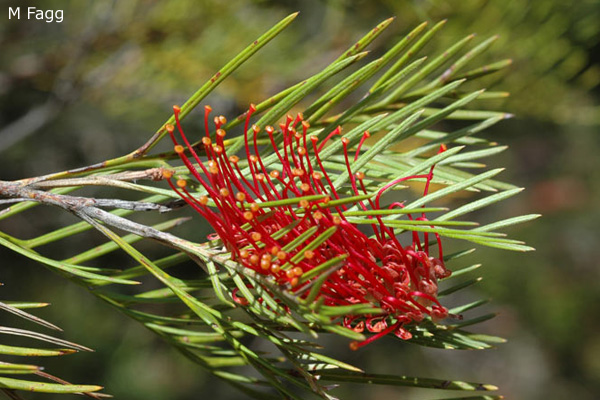
Grevillea ‘Red Hooks’
Photo: Murray Fagg – Australian National Botanic Gardens