 Australian Native Plants Society (Australia)
General Description:
Grevillea masonii is a relatively new discovery having being first collected in the 1970s and formally named in 1994. It is a low growing species reaching about 0.5 metres high by a similar width. The leaves are about 15-20 mm long and elliptical or oblong in shape. The flowers are red with a green base and occur in few-flowered clusters from the leaf axils. Flowering occurs in late winter and spring.
Although a recent discovery, Grevillea masonii is becoming popular in cultivation as it has proven to be hardy in a range of climates and well drained soils. Combined with its small size and attractiveness to birds, it is an ideal plant for the native garden. It prefers a sunny or partly shaded position and appears to tolerate extended dry conditions once established.
Propagation can be carried out from cuttings of firm, current seasons growth which strike easily. Seed may be successful. Propagation from seed (which is not readily available) should also be successful – seed should be “nicked” with a sharp knife prior to sowing to improve germination.
* EPBC Act = Environment Protection and Biodiversity Conservation Act 1999;
ROTAP = Rare or Threatened Australian Plants (Briggs and Leigh, 1988)
For further information refer the Australian Plants at Risk page
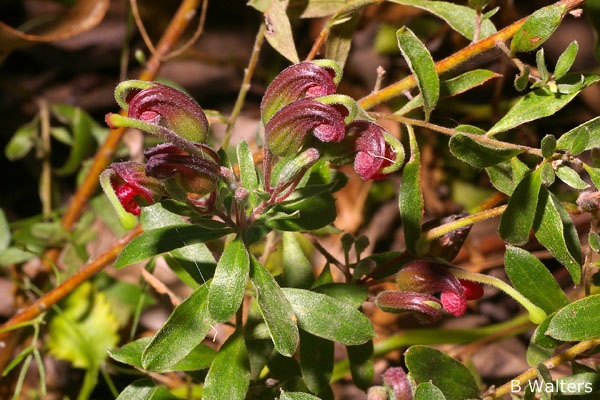
Grevillea masonii
Photo: Brian Walters