 Australian Native Plants Society (Australia)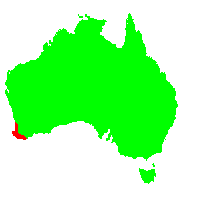
General Description:
Banksia ilicifolia, Banksia cuneata and B.oligantha are three species which comprise a distinctive group within the genus Banksia. The flower clusters of these three species resemble those of the ‘Dryandra Group’ – species in the former genus Dryandra) but lack the overlapping, scale-like bracts which surround the clusters and often form a conspicuous part of the inflorescences of that group. All three species occur naturally only in Western Australia.
Holly-leaved banksia is typically a large tree to about 10 metres high with thick, fibrous bark and stiff, oval-shaped leaves with prickly, toothed margins. Some populations along the southern coast of Western Australia may be much smaller and can sometimes be seen with a shrubby growth habit. The leaves are about 100 mm long by 30 mm wide. Flowers occur mainly in late winter to early summer but some flowers may be seen at most times of the year. The flower clusters occur at the ends of the branches (terminal) and are around 50 mm diameter. The flower colour is cream and pink, turning deep pink to red as the flowers age.
The seeds are enclosed in follicles attached to a woody cone and are generally retained within the cone until burnt. The cone has an unusual shape and usually has only a few follicles.
B.ilicifolia is fire-resistant in that it can regenerate vegetatively from epicormic shoots after brushfires.
B.ilicifolia is not widely cultivated but should be suited to areas with a dry summer climate. It may be difficult to maintain in areas of high summer humidity. It requires well drained soils in full sun and, like all banksias, it is excellent for attracting honey eating birds. Low growing forms should be particularly suitable for cultivation.
The species is generally propagated from seed which usually germinates reliably. Propagation from cuttings may be possible but the success rate is likely to be low.
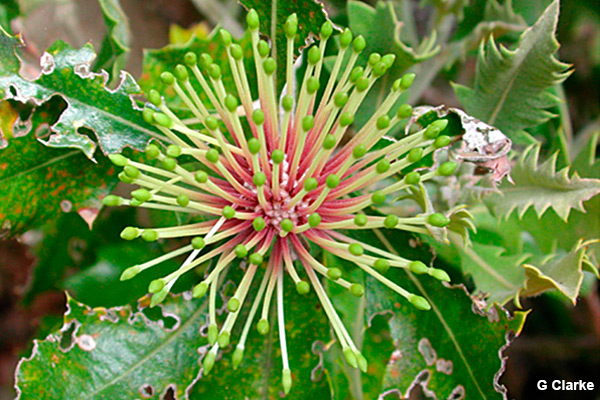
Banksia ilicifolia flowers in bud
Photo: Gwyn Clarke
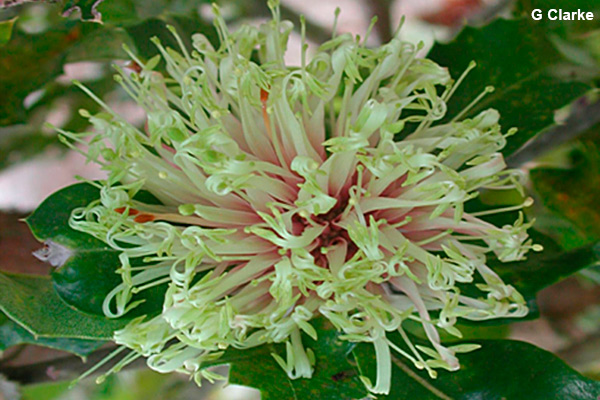
The flowers of Banksia ilicifolia deepen in colour as they age
Photo: Gwyn Clarke
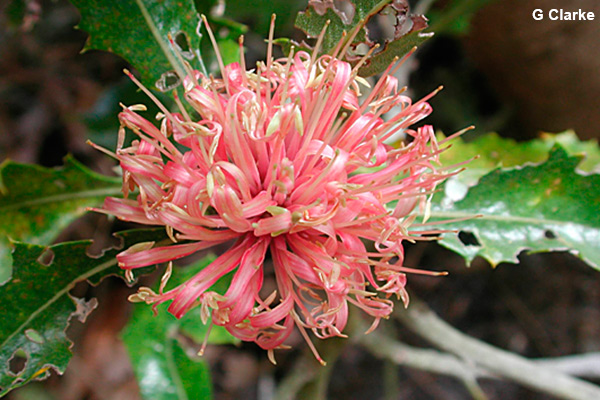
The flowers of Banksia ilicifolia deepen in colour as they age
Photo: Gwyn Clarke
Other Native Plant Profiles